
Leather diaries and journals are the everlasting ones which are fashionable and helpful. It is impossible to duplicate leather-bound notebooks, whether one is writing inside it the way he/she choose, making notes, or even writing about some memorable events. However, these prized possessions must be handled, and the leather journals should be preserved using the correct leather journal care and leather diary care to be in a position to survive years in their best condition. It is a simple, yet useful instruction that would enable you to take good care of, clean and preserve your leather journal in safe, supple and beautiful condition.
Leather is a natural product which must be maintained in order to be soft and durable. Leather journals can dry or crack, or they can be stained without being taken care of. Caring for the leather, such as keeping a diary, helps preserve the natural oils in the leather, and therefore it is not as brittle and lasts longer on your notebook. Unless you wish your leather journal to lose the textured appearance and feel, you should strike a compromise on good leather care habits.
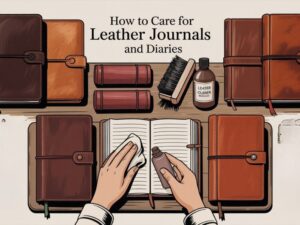
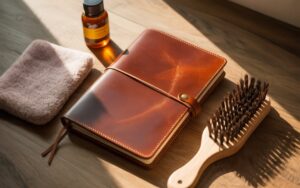
Leather journal care also consists of a basic cleaning that is very crucial. A soft, dry cloth should be used to dust off the surface of your leather diary at frequent time intervals so that the accumulated dirt can be removed before it can produce any abrasive effect that may damage the diary. In order to clean deeper, wipe the cover with a somewhat wet linen-free cloth. Ensure that you do not put the leather in too much water or wet it. The chemicals that should not be used include crude chemicals, soaps or household cleaners, as they strip the leather of its natural oil content.
In case of a dirty or scribbled leather journal, first apply on a little inconspicuous area a weak leather cleaner or special saddle soap. One should rub the dirt on a soft cloth so that the surface is not spoiled. Such measures are the simple cleaning rules of effective tips on taking care of leather notebooks.
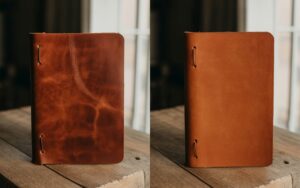
Conditioning is another of the most significant elements of the leather diary maintenance, as it leaves the leather soft and wet. A leather conditioner is suggested after some time; fibrous nourishment of leather in this manner will not end up being dry and fissured. Rub the conditioner on the leather, carefully, not to miss any part of the leather. To use or store the journal, allow the conditioner to dry naturally and absorb.
Leather conditioners are of different types, which include cream-based, oil-based and wax-based, and they are applied to the leather type and its condition. The use of conditioners that involve cream-based conditioners is to take care of the leather because they introduce moisture, in addition to enhancing the natural shine of the leather. With the correct application of conditioners to leather, your leather journal will last longer and have a supple appearance.

One of the major considerations towards the care of leather journals is that the leather should not be exposed to bad environmental conditions. Leather diaries should not be subjected to direct sunlight because this can easily cause them to fade and dry. Similarly, keep your leather journal in such locations that are not hot, such as radiators or open fire, which can dry up the leather and ruin it. Wetness is the other enemy, and hence, avoid spills of water and damp places. Provided that your leather journal feels wet, then you should leave it to dry slowly at room temperature.
You require adequate storage for your notebooks in the shape of leather journals. Always keep your leather diaries in a dry, cool environment and not in direct sunlight or high humidity. To prevent dust and scratches on the leather journal, it can be kept in a breathable fabric pouch or a protective cover. The notebook should not be loaded with more papers and objects, as this will overstretch the leather, leading to deformation of the journal. The adequate storage techniques will contribute to the maintenance of the leather in the long term and avoid unwanted damage.
How you handle your leather journal is also a factor that determines how long it will last. Do not place heavy items or drop heavy items upon the journal because it will produce dents or cracks. When using your leather diary, you should also be in possession of the same and ensure that it is not exposed to sharp objects that can scratch the surface. Periodically, check your journal to see whether it is not dry or is damaged and be sure to deal with any anomalies as soon as possible by cleaning or conditioning.
The knowledge of how to care for leather journals and keep leather diaries is not dependent on numerous hard tools and complicated operations. The most significant actions would consist of washing it with a soft cloth regularly, conditioning the leather periodically with proper leather products, keeping the leather out of the sun and moisture and ensuring that the journal is kept in an appropriate way. These steps will result in having a high-end, soft and long-lasting leather diary.
No matter whether you were given a family heirloom journal or whether you had just purchased a nice leather notebook, the essentials of preservation are how to clean leather journals, tips on leather conditioners, and how to protect your leather journals. No one can be turned into a friend with your leather notebooks, and you can be sure that your friends will recount your stories in a stylish manner and with much life when handled carefully.
When you write in your leather diary, you inoculate it with tradition, so that it will never become unattractive to your subsequent recollections. Remember, however, that it is no chore, but an enjoyable ritual that leaves your memories on such an eternally living surface as your writing.